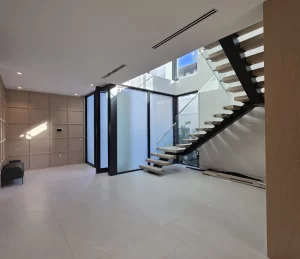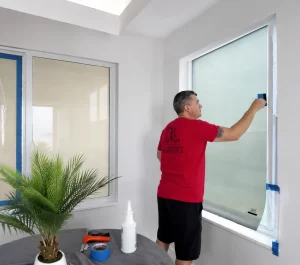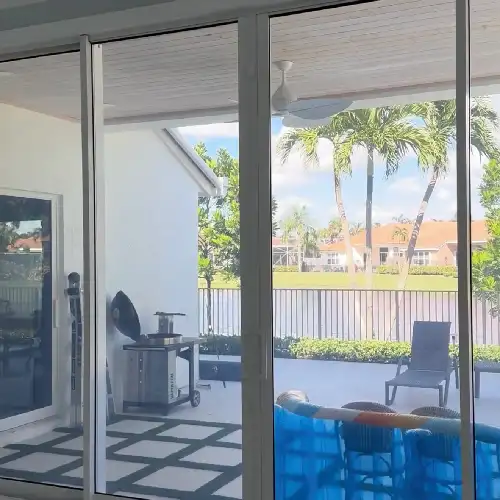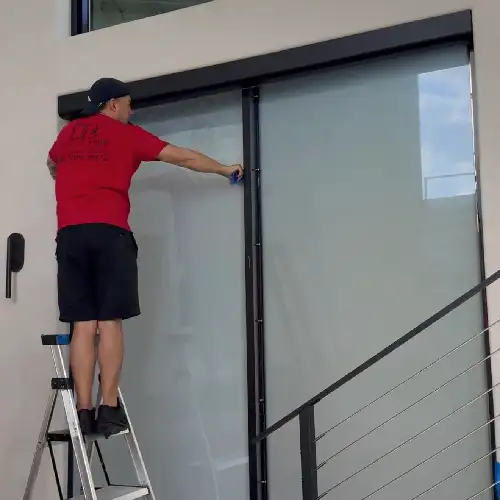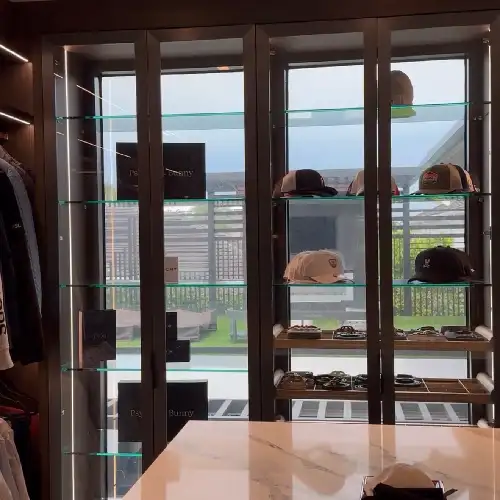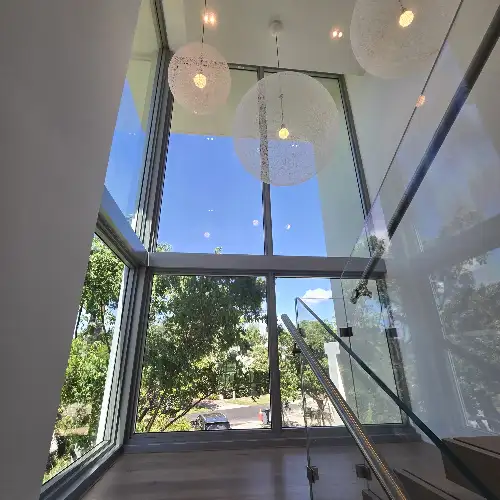
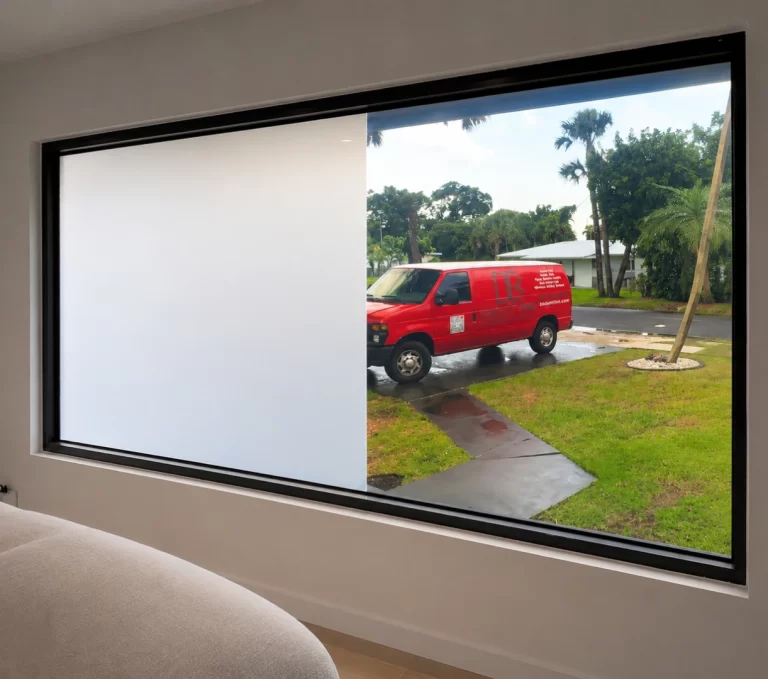
Electrified switchable privacy glass changes from clear to frosted with power control.
When the glass is on, it becomes clear. When the glass is off, it becomes frosted and private. This clear-to-frosted change comes from PDLC technology, which uses liquid crystal molecules inside a film layer within the glass. When voltage is applied, the molecules line up and allow light to pass through. When power is off, the molecules scatter light and the glass looks frosted.
This is the same basic technology used in many smart glass shower doors, bathroom smart glass windows, office partitions, conference rooms, clinics, and privacy glass panels.
What is switchable privacy glass?
Switchable privacy glass is glass that can change between 2 states:
- Clear glass
- Frosted privacy glass
It is also called:
- Electric privacy glass
- Electric frosted glass
- Smart glass
- PDLC smart glass
- Switchable glass
- Electrified privacy glass
The goal is simple. You keep the look of glass, natural light, and an open room when privacy is off. When privacy is needed, the glass turns frosted.
This makes it useful for bathrooms, shower doors, bathroom windows, meeting rooms, medical rooms, retail spaces, and shared office layouts.
How the clear-to-frosted change happens
The glass has a PDLC layer inside it.
PDLC means polymer dispersed liquid crystal. The layer contains liquid crystal droplets inside a polymer material. This layer sits between conductive surfaces so it can respond to electricity. Gauzy explains that PDLC smart glass needs electricity to switch states and becomes transparent when low voltage aligns the molecules.
Here is the simple version.
When power is off:
- The liquid crystal molecules sit in random positions
- Light scatters inside the glass
- The glass looks frosted
- The view through the glass is blocked
- The room still receives soft light
When power is on:
- The liquid crystal molecules line up
- Light passes through the glass
- The glass becomes clear
- The space feels open again
This is why switchable privacy glass is often described as clear when powered and private when unpowered. Dash Door explains the same principle: power off makes the liquid crystals scatter light, and power on lines them up so light can pass through.
Is switchable privacy glass clear or private when the power is off?
Most PDLC switchable privacy glass is private when the power is off.
That means the glass returns to a frosted state during a power loss. For privacy spaces, this is useful because bathrooms, shower areas, clinics, and meeting rooms stay private when the system is not powered.
When power is applied, the glass becomes clear.
This matters when planning:
- Smart glass shower doors
- Bathroom smart glass
- Privacy glass for bathroom windows
- Clinic partitions
- Conference room glass
- Office doors
- Reception glass
- Hotel bathroom glass
Is switchable privacy glass the same as smart glass?
Yes, in many cases.
Smart glass is the broader term. Switchable privacy glass is one type of smart glass.
PDLC smart glass is the type most people use when they want instant privacy. It changes from clear to frosted fast, often in milliseconds. Gauzy describes PDLC smart glass as an active glass technology that can switch on, off, or to states between those points.
For most bathroom, shower, office, and clinic privacy projects, PDLC smart glass is the product people mean when they ask for switchable privacy glass.
How is switchable privacy glass made?
Switchable privacy glass is usually laminated.
That means the PDLC film layer is placed between 2 glass panels and bonded into one glass unit. Conductive coatings and wiring allow electricity to reach the PDLC layer. Dash Door describes this as laminated glass with liquid crystal privacy film inside, connected to wiring so the film responds to electrical current.
A typical laminated switchable glass panel includes:
- Outer glass layer
- Conductive layer
- PDLC privacy film
- Conductive layer
- Outer glass layer
- Wiring connection
- Transformer or controller
The transformer supplies the correct voltage for the system. The switch, remote, app, or smart control tells the glass when to turn clear or frosted.
What does the transformer do?
The transformer reduces and controls the power going to the glass.
Switchable privacy glass does not run like a normal light fixture. It needs the correct low-voltage supply for the PDLC layer. The transformer connects the building power to the glass system and sends the right electrical output to the smart glass panel.
For clean installation, the wiring and transformer location should be planned before the glass is installed.
This is especially important for:
- Smart glass shower doors
- Switchable glass shower doors
- Bathroom glass walls
- Office partitions
- Large conference rooms
- Multi-panel glass systems
How can you control switchable privacy glass?
Switchable privacy glass can be controlled in several ways.
Common options include:
- Wall switch
- Remote control
- Mobile app
- Voice control
- Motion sensor
- Smart home system
- Office control system
For bathrooms, many clients choose a wall switch or remote.
For offices, clinics, and commercial spaces, multiple panels can often be connected to the same control system.
Where switchable privacy glass works best
Switchable privacy glass works best where a space needs both openness and privacy during different parts of the day.
Bathrooms and showers
Bathroom use is one of the strongest fits.
A smart glass shower door can stay clear when the bathroom is open and turn frosted when someone uses the shower.
Common bathroom uses include:
- Smart glass shower
- Switchable glass shower door
- Privacy glass shower doors
- Shower privacy glass
- Privacy shower glass
- Smart glass bathroom windows
- Privacy glass for bathroom windows
- Smart glass bathroom door
- Bathroom glass walls
This gives privacy without curtains, blinds, or permanent frosted glass.
Residential spaces
In homes, switchable privacy glass works well in bathrooms, bedrooms, entryways, home offices, and glass room dividers.
Homeowners often use it where they want privacy without closing off the room or blocking light.
Good residential uses include:
- Master bathroom shower doors
- Guest bathroom windows
- Bedroom glass walls
- Front entry glass
- Home office glass
- Interior glass partitions
Offices and conference rooms
Offices use switchable privacy glass in conference rooms, private offices, meeting rooms, HR rooms, and executive spaces.
Glass keeps the office open during normal use. Frosted mode gives privacy during calls, meetings, interviews, and presentations.
Clinics and healthcare spaces
Healthcare spaces use switchable privacy glass for consultation rooms, treatment rooms, exam areas, ICU doors, reception partitions, and clinic glass.
It gives patient privacy and keeps the glass surface easier to clean than fabric curtains.
Retail and showrooms
Retail stores can use switchable privacy glass for fitting rooms, private consultation areas, display sections, and storefront areas.
Some businesses also use frosted mode for projection or to hide sections of the store after hours.
Hotels and hospitality spaces
Hotels use smart glass in bathroom partitions, shower enclosures, suites, spas, and private guest areas.
A hotel bathroom can feel more open when the glass is clear and more private when the glass turns frosted.
Does switchable privacy glass block all light?
No. Standard PDLC switchable privacy glass gives privacy, but it still allows light through.
When the glass is frosted, it blocks a clear view. It does not make the room completely dark.
This is useful in bathrooms and offices because the space can stay bright while the glass is private.
If the project needs darkness, shading, or blackout, a different product may be needed. Electrochromic glass, SPD glass, dark smart film, or layered systems may be used for those goals.
Does switchable privacy glass turn black?
Standard PDLC switchable privacy glass usually turns frosted white or light grey.
It does not turn solid black.
For bathroom privacy, frosted glass is usually the better result because it keeps light in the room. For sun-facing windows or blackout needs, dark tinting or electrochromic glass may be a better product category.
Switchable privacy glass vs electric window tint
Switchable privacy glass and electric window tint are related, but the installation method can differ.
Option | What it is | Best use |
Switchable privacy glass | Laminated smart glass with PDLC inside | New glass, shower doors, bathroom glass, custom projects |
Electric window tint / smart film | Switchable film applied to existing glass | Existing office glass, flat windows, retrofit partitions |
Electrochromic glass | Glass that gradually tints darker | Exterior windows, glare, heat control |
For a smart glass shower door, laminated switchable glass is usually the cleaner option.
For an existing office partition, electric window tint or smart film may be the better fit.
Can switchable privacy glass be used in showers?
Yes, switchable privacy glass can be used for showers when the right product and installation method are selected.
Bathroom and shower projects need careful planning because they involve water, humidity, cleaning, hardware, and moving glass.
Before installation, the team should review:
- Shower layout
- Door swing or sliding system
- Glass size
- Water exposure
- Power access
- Wiring path
- Control location
- Hardware choice
- Cleaning needs
This is why smart glass shower door projects should be measured on site before pricing.
Smart glass shower door price factors
The price of a smart glass shower door depends on the project.
Main cost factors include:
- Glass size
- Shower door type
- Fixed panel or moving door
- Number of panels
- Glass thickness
- Control method
- Wiring access
- Hardware
- Installation conditions
- Custom fabrication
A single switchable glass shower door usually costs less than a full smart glass shower enclosure with multiple panels.
For accurate pricing, the space needs an on-site measurement.
Installation process for switchable privacy glass
A good installation starts before the glass arrives.
1. Consultation
The installer reviews the space, privacy goal, glass type, and control preference.
For bathrooms, this includes shower layout, water exposure, and power access.
2. On-site measurement
The installer measures the opening and checks the frame, walls, glass area, wiring path, and installation conditions.
This step matters because switchable privacy glass is custom sized.
3. Product planning
The installer chooses the right smart glass, control method, transformer location, and wiring plan.
For shower doors, the team also reviews door movement, hardware, and sealed areas.
4. Installation and testing
The team installs the glass, connects the wiring, tests the clear and frosted modes, checks the controls, and cleans the work area.
The glass should be tested before the project is handed over.
Common problems when switchable privacy glass is planned poorly
Switchable privacy glass needs careful planning.
Common issues include:
- Wrong glass size
- Poor wiring route
- Visible wires
- Wrong transformer location
- Weak control placement
- Product mismatch for wet areas
- Poor edge finish
- No clear access for service
These issues can be avoided when the installer reviews the full space before quoting and installation.
FAQs
How does switchable privacy glass work?
Switchable privacy glass uses PDLC technology.
When power is on, the liquid crystal molecules line up and the glass becomes clear. When power is off, the molecules scatter light and the glass becomes frosted.
What does PDLC mean?
PDLC means polymer dispersed liquid crystal.
It is the liquid crystal layer inside many smart glass and switchable privacy glass products.
Is switchable privacy glass clear when on or off?
Most PDLC switchable privacy glass is clear when power is on and frosted when power is off.
Does switchable privacy glass need electricity?
Yes. PDLC switchable privacy glass needs electricity to switch states and stay clear.
When power is off, it usually returns to the frosted privacy state.
Can switchable glass be used for shower doors?
Yes. Switchable glass can be used for shower doors when the correct product and installation method are used.
A smart glass shower door gives privacy on demand while keeping the bathroom bright.
Is switchable glass good for bathroom privacy?
Yes. It works well for bathroom privacy because it can turn frosted when privacy is needed.
It can be used for shower doors, shower panels, bathroom windows, bathroom doors, and bathroom glass walls.
Does switchable privacy glass turn black?
Standard PDLC switchable privacy glass turns frosted white or light grey.
It does not turn solid black.
Can switchable privacy glass be controlled by phone?
Yes, many systems can connect with mobile controls or smart systems.
The available control options depend on the product, controller, and wiring setup.
Is switchable privacy glass better than blinds?
For glass-heavy spaces, switchable privacy glass gives privacy without adding blinds, curtains, or cords.
It is often used where the owner wants a cleaner glass finish and fast privacy control.
Where can switchable privacy glass be used?
It can be used in bathrooms, shower doors, bathroom windows, offices, conference rooms, clinics, hotels, retail stores, coworking spaces, and glass partitions.
Need switchable privacy glass in Miami?
Smart Tint Solutions installs smart glass shower doors, switchable glass shower doors, bathroom smart glass, electric frosted glass, office privacy glass, clinic privacy glass, and commercial smart glass across Miami and South Florida.